
Outflow of Profit Beats Foreign Direct Investment by 32pc
June 19, 2026
Govt Reduces Petrol Price by Rs74 Per Litre, Diesel by Rs67 Per Litre
June 19, 2026
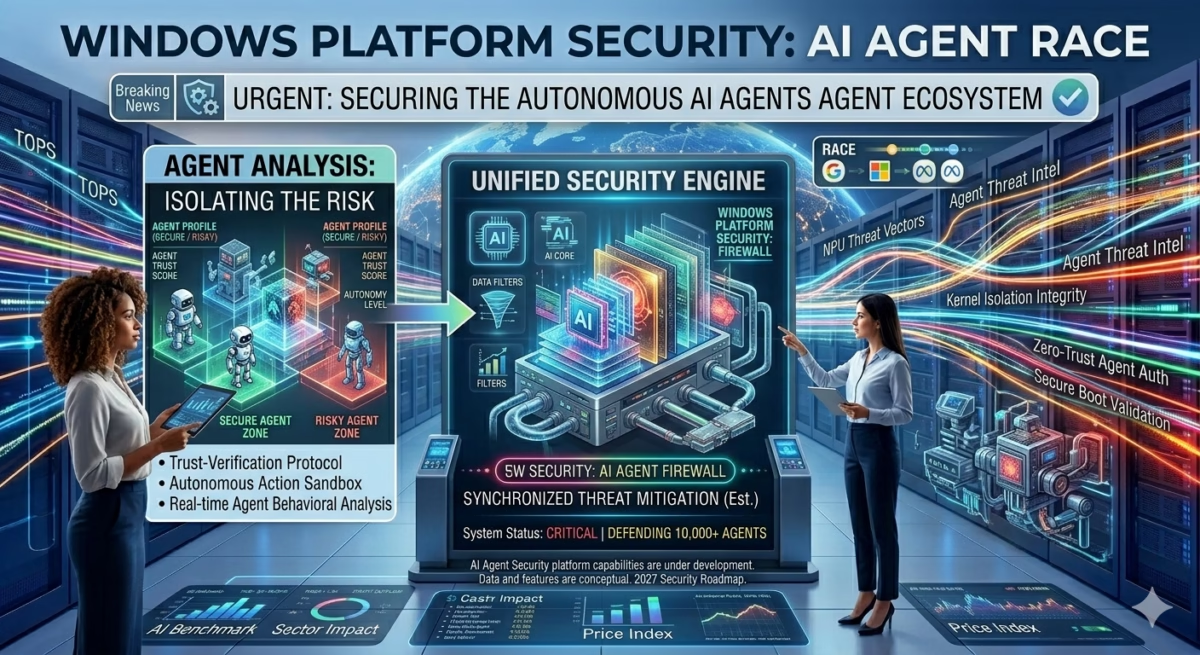
Windows Platform Security and the Race to Secure AI Agents
Microsoft is rapidly reshaping Windows security architecture to handle a new challenge: AI agents that can act autonomously on behalf of users. As these agents become capable of accessing files, running tasks, and interacting with system tools, Windows is being redesigned to ensure they operate safely without creating new security risks.
The core idea behind Windows platform security for AI agents is simple: AI is no longer just an app feature—it is becoming part of the operating system itself, and therefore must be secured at the same level as core system processes.
Why AI Agents Change Windows Security
AI agents behave differently from traditional software because they can:
- Perform multi-step tasks automatically
- Access system files and applications
- Use APIs and external tools
- Make decisions without constant user input
This creates a new category of risk where software is not just executing commands—it is deciding what to do next. That makes security more complex than traditional permission-based app models.
Microsoft’s Shift Toward Agent-Aware Security
Microsoft is integrating AI agent protection directly into Windows rather than treating it as an add-on feature.
The goal is to create a system where:
- Every AI agent has a defined identity
- Actions are logged and traceable
- Permissions are strictly controlled
- Behavior is monitored in real time
Instead of trusting apps, Windows must now also manage trust in autonomous agents.
Agents Need Operating System-Level Control
Security researchers compare AI agents to system processes because they:
- Access memory and files
- Communicate with other services
- Run background tasks
- Persist across workflows
This means they require similar protections such as isolation, privilege separation, and controlled execution environments.
In many proposed models, AI agents are treated like “digital workers” inside the OS, each operating under strict boundaries.

Microsoft Build and AI Security Direction
Microsoft has been expanding its focus on using AI not only for productivity but also for security.
A key trend is the use of AI systems to:
- Detect vulnerabilities in code
- Simulate attacks on software
- Identify weak points in system components
- Improve secure development pipelines
This reflects a shift where AI is both the tool and the target of security systems.
Key Security Layers for AI Agents in Windows
Windows platform security for AI agents typically includes several layers:
Identity-Based Control
Each agent is assigned a unique identity for tracking and permission management.
Least-Privilege Access
Agents only receive the minimum permissions required for their tasks.
Runtime Monitoring
System behavior is continuously analyzed to detect suspicious actions.
Policy Enforcement
Rules define what agents can and cannot do within the system.
Audit Logging
Every action performed by an agent can be reviewed later for security analysis.
New Threats Introduced by AI Agents
AI agents also introduce new types of security risks, including:
Prompt Injection Attacks
Malicious instructions hidden in data can manipulate agent behavior.
Excessive Permissions
Agents may unintentionally gain access to sensitive system areas.
Data Leakage
Autonomous actions may expose confidential information.
Multi-Agent Conflicts
Multiple agents interacting can create unpredictable system behavior.
The Idea of an “Agent Operating Layer”
Researchers increasingly suggest that AI agents require a dedicated operating layer inside modern systems.
This layer would handle:
- Secure communication between agents
- Controlled execution of tasks
- Isolation from critical system components
- Verification of agent decisions
The goal is to prevent agents from acting outside their intended boundaries.
The Future of Windows Security
Microsoft appears to be moving toward an agent-first Windows model, where:
- AI handles routine tasks
- Applications become secondary interfaces
- Users interact through natural language
- System workflows are automated by agents
In this model, security becomes even more critical because AI is deeply integrated into system operations.
Challenges Ahead
Despite progress, several challenges remain:
- Complexity of multi-agent systems
- Difficulty in predicting AI behavior
- Integration with legacy Windows components
- Ensuring consistent security policies
- Preventing misuse of autonomous actions
Security experts agree that protecting AI agents will require continuous adaptation rather than a fixed solution.
Conclusion
Windows platform security is evolving rapidly to address the rise of AI agents. As these systems become more autonomous and deeply integrated into operating systems, Microsoft is building a framework that treats AI agents as controlled, monitored, and fully governed components of Windows.
The shift marks a major step toward a future where operating systems are not just running applications—but managing intelligent agents that act on behalf of users.
FAQs
What are AI agents in Windows?
AI agents are autonomous systems that can perform tasks and interact with software on behalf of users.
Why do AI agents create security risks?
Because they can access sensitive data and take actions without constant human supervision.
How is Microsoft securing AI agents?
By using identity controls, permissions, monitoring systems, and policy enforcement.
What is the main security concern with AI agents?
Uncontrolled actions caused by prompt injection or excessive permissions.
Will AI agents replace traditional apps?
They are more likely to complement apps by automating tasks rather than fully replacing them.