

Gas Recovery to Take 1 Year Post-Conflict: GECF CEO on Iran Energy Crisis
April 23, 2026
Pakistani Co-Founder’s Cursor AI Lands $60B SpaceX Deal Sualeh Asif
April 24, 2026
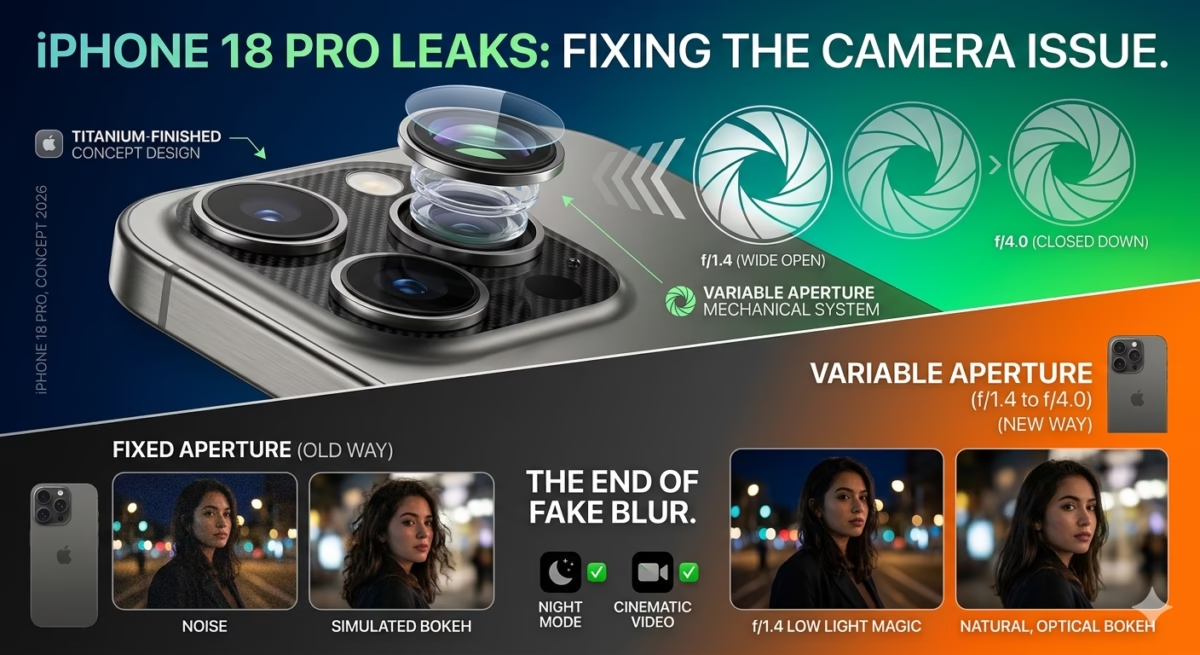
iPhone 18 Pro Leaks Point to Fix for Apple’s Long-Standing Camera Issue: The Variable Aperture Era
As we approach the second half of 2026, the tech world is buzzing with early leaks regarding the iPhone 18 Pro. According to recent reports and industry insiders, Apple is finally set to address a long-standing limitation in its camera system: the lack of a variable aperture. This move, as detailed in recent tech chronicles, marks the most significant architectural change to the iPhone’s camera since the introduction of the three-lens system.
1. The “Fixed Aperture” Problem
For years, iPhone cameras have utilized a “fixed aperture.” While Apple has made incredible strides in computational photography, the physical lens has remained static. This creates a specific issue in photography: the inability to control the amount of light entering the sensor physically and, more importantly, the inability to adjust the depth of field naturally.
Currently, when you take a photo with an iPhone, the “Bokeh” (background blur) is largely simulated via software. The iPhone 18 Pro leaks suggest that Apple is moving toward a mechanical solution, allowing the lens to open and close just like a professional DSLR or mirrorless camera.
2. The Solution: Variable Aperture Technology
The rumored “fix” involves a variable aperture system, likely ranging from f/1.4 to f/4.0.
- Low Light Performance: At f/1.4, the lens will be wide open, allowing significantly more light to hit the sensor. This will reduce “noise” in night photography without relying solely on long-exposure software modes.
- Natural Sharpness: At f/4.0, the lens provides a deeper focus, making it ideal for landscape photography where you want both the foreground and background to be sharp.
- Optical Bokeh: Instead of the software-driven “Portrait Mode,” a variable aperture allows for natural, optical background blur, which looks significantly more professional and handles complex edges (like hair) much better than AI can.
3. Impact on Video: Cinematic Precision
The variable aperture isn’t just for stills; it is a game-changer for videographers. One of the biggest challenges with the current iPhone is shooting in bright daylight. Because the aperture is fixed and wide open, the shutter speed must be incredibly high, resulting in “choppy” motion.
With the iPhone 18 Pro, users could physically stop down the aperture to f/4.0 in bright sunlight. This allows for a slower shutter speed, resulting in that smooth, cinematic motion blur that professional filmmakers demand. It effectively reduces the need for external ND filters in many common shooting scenarios.
4. Why Now? The Hardware-Software Convergence
Critics have long asked why Apple took so long to implement this, especially since some Android competitors experimented with it years ago. The delay is likely due to Apple’s strict requirements for durability and miniaturization.
Implementing a moving mechanical part inside a device that people drop, shake, and expose to water is a massive engineering hurdle. The 2026 leaks suggest that Apple has finally perfected a “compact actuator” system that provides the precision of a mechanical lens without compromising the iPhone’s IP68 water resistance or its thin profile.
5. Future Outlook: Pro Photography in Your Pocket
If these leaks hold true, the iPhone 18 Pro will represent a “re-baselining” of what a smartphone camera can do. By fixing the long-standing limitation of fixed optics, Apple is moving closer to its goal of making the iPhone a viable tool for professional photography and independent filmmaking.
Frequently Asked Questions (FAQs)
1. What is a variable aperture in a smartphone?
It is a mechanical system that allows the camera lens to physically change the size of its opening. This controls how much light enters the camera and determines how much of the background is blurred.
2. How will this improve my photos compared to an iPhone 15 or 16?
The main difference will be in natural-looking portraits and better low-light shots. Instead of the phone “guessing” where the background blur should start using AI, the lens will create the blur physically, making photos look like they were taken with a professional camera.
3. Does this mean Portrait Mode is going away?
No, Portrait Mode will likely remain as a software option, but the hardware will now support it. This means the transition between the subject and the blurred background will look much smoother and more accurate.
4. Will this make the camera “bump” on the back larger?
Leaks suggest the camera housing may remain a similar size, but the internal components will be more complex. Apple’s challenge is fitting the moving parts of the aperture into the existing 18 Pro design.
5. When is the iPhone 18 Pro expected to be released?
Following Apple’s traditional release cycle, the iPhone 18 Pro is expected to be announced in September 2026.
Elevate Your Brand with MasterInDesign
Don’t let your business get left behind in today’s fast-paced digital world. At MasterInDesign, we specialize in helping brands stand out, engage audiences, and grow online.
Take the next step toward digital excellence. Contact us today and transform your brand into a powerful online