

US-Iran Hormuz Standoff: Global Oil Prices Surge Ahead of Ceasefire Expiry
April 22, 2026
Gas Recovery to Take 1 Year Post-Conflict: GECF CEO on Iran Energy Crisis
April 23, 2026
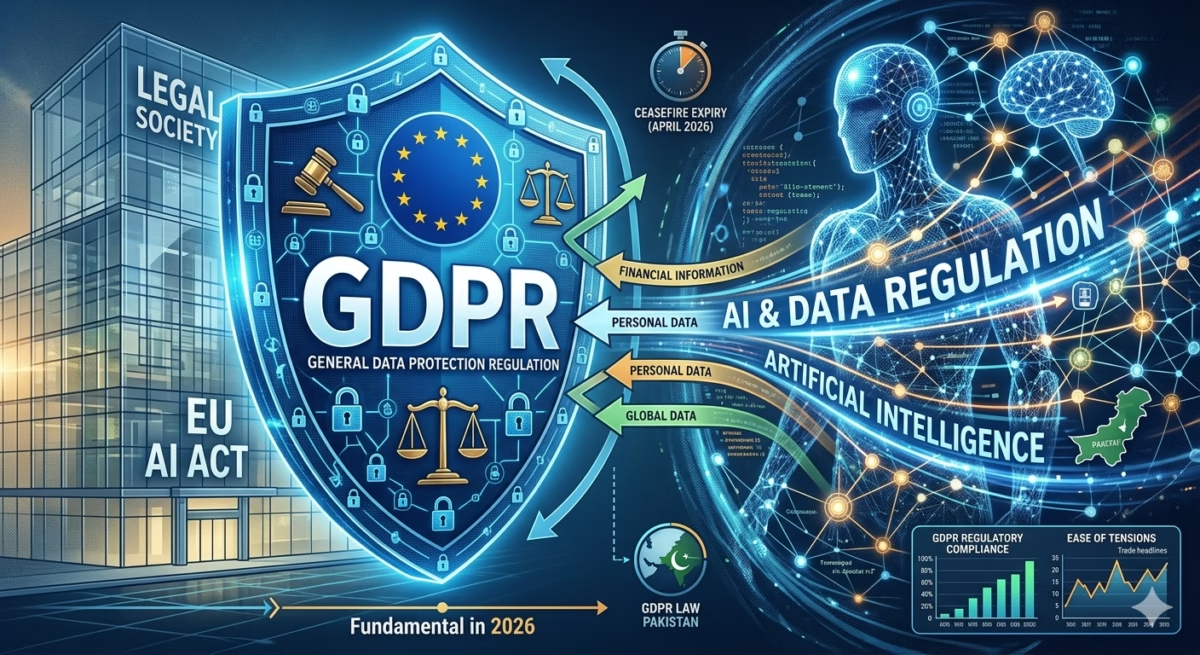
GDPR Still ‘Fundamental’ to AI Regulation: Navigating the Future of Data Privacy in the Age of Intelligence
As we progress through 2026, the meteoric rise of generative models and autonomous agents has forced a global re-evaluation of how we govern technology. Despite the introduction of specialized frameworks like the EU AI Act, the General Data Protection Regulation (GDPR) remains the bedrock of AI and data regulation. According to recent insights from legal experts and the Law Society, GDPR is not merely a legacy law; it is a fundamental pillar that ensures human rights are protected in an increasingly algorithmic world.
1. Why GDPR AI Regulation is More Relevant Than Ever
When discussing GDPR AI regulation, we are addressing the tension between the “hunger” of AI for data and the individual’s right to privacy. AI systems, particularly Large Language Models (LLMs), require vast datasets for training. However, the core principles of GDPR—such as data minimization, purpose limitation, and storage limitation—act as a necessary brake on the unchecked harvesting of personal information.
In 2026, the “black box” nature of AI remains a challenge. GDPR provides the legal tools to demand transparency. Under the regulation, individuals have the right not to be subject to a decision based solely on automated processing, including profiling, which produces legal effects. This makes AI and GDPR inseparable partners in the quest for “Explainable AI.”
2. The Synergy: EU AI Act and GDPR
There is a common misconception that the new AI-specific laws have superseded privacy regulations. In reality, the EU AI Act and GDPR function as a dual-layered shield. While the AI Act focuses on the safety, transparency, and risk levels of the AI application itself (categorizing them into prohibited, high, and limited risk), GDPR governs the “fuel” of those systems: the personal data.
For instance, if a company deploys an AI-driven recruitment tool, the AI Act ensures the algorithm is unbiased and technically robust, while GDPR ensures that the candidates’ CVs and personal details are processed lawfully, transparently, and securely.
3. Technical Hurdles: GDPR Artificial Intelligence Challenges
Integrating GDPR artificial intelligence standards into modern software architecture presents several technical “friction points” that developers in 2026 are still working to solve:
- The Right to Erasure (The Right to be Forgotten): If a person’s data has been ingested into a neural network during the training phase, “deleting” that data is not as simple as removing a row from a database. 2026 has seen the rise of “Machine Unlearning” techniques to address this specific GDPR requirement.
- Data Accuracy: GDPR mandates that personal data must be accurate. AI “hallucinations”—where a model confidently states a false fact about a person—constitute a direct violation of data accuracy principles when that output is used for decision-making.
- Data Minimization vs. Big Data: AI thrives on “more,” while GDPR thrives on “only what is necessary.” Striking this balance is the primary task of GDPR regulatory compliance officers today.
4. Financial Sensitivity: Does GDPR Apply to Financial Information?
A frequently asked question in the Fintech sector is: Does GDPR apply to financial information? The answer is an emphatic yes. Financial data is considered highly sensitive, even if it does not always fall under the “special categories” of data (like health or religion).
In the 2026 economy, where AI-driven credit scoring and automated wealth management are standard, GDPR protects users from the unauthorized sharing of their transaction histories and prevents “predatory profiling” by financial bots. Any AI system handling banking data must implement the highest levels of encryption and pseudonymization to remain compliant.
5. Global Impact: GDPR Law Pakistan and Beyond
The influence of European standards has reached far beyond EU borders, creating a “Brussels Effect.” In South Asia, while local acts like the GDPR law Pakistan context (referring to the Personal Data Protection Bill and related frameworks) are being refined, Pakistani tech firms exporting AI services to Europe must strictly adhere to GDPR.
For Pakistani software houses and AI startups, GDPR regulatory compliance is no longer a luxury—it is a prerequisite for international trade. Compliance ensures that local developers can compete on a global scale by proving their systems are “Privacy by Design” compliant.
6. The 2026 Compliance Landscape
Today, ai and gdpr compliance has moved from a “check-the-box” exercise to a continuous monitoring process. Organizations are now using “AI for Compliance”—using specialized algorithms to audit other AI models for privacy leaks. This meta-regulation ensures that as AI evolves, the protections afforded by GDPR evolve with it.
Frequently Asked Questions (FAQs)
Q1: Is GDPR enough to regulate AI on its own?
A1: While GDPR is fundamental for protecting personal data, it doesn’t cover all AI risks, such as physical safety or systemic bias. This is why it works alongside the EU AI Act to provide a complete regulatory framework.
Q2: What is “Privacy by Design” in AI?
A2: It means that privacy protections are integrated into the AI development process from the very first line of code, rather than being added as an afterthought. This is a core requirement for GDPR compliance in 2026.
Q3: Can an AI model be “fined” under GDPR?
A3: A model cannot be fined, but the organization that owns or operates the model can be. Fines can reach up to 4% of a company’s global annual turnover for severe violations of data processing principles.
Q4: How does GDPR protect against AI-driven identity theft?
A4: GDPR requires companies to implement “State of the Art” security measures. If an AI database is breached due to negligence, the company is liable for the damages and must report the breach to authorities within 72 hours.
Q5: Does GDPR allow the use of public data for AI training?
A5: Not automatically. Just because data is “public” (like a social media profile) doesn’t mean it can be used for any purpose. Companies must still have a “legal basis” (like legitimate interest or consent) to scrape and use that data for AI training.
Elevate Your Brand with MasterInDesign
Don’t let your business get left behind in today’s fast-paced digital world. At MasterInDesign, we specialize in helping brands stand out, engage audiences, and grow online.
Take the next step toward digital excellence. Contact us today and transform your brand into a powerful online